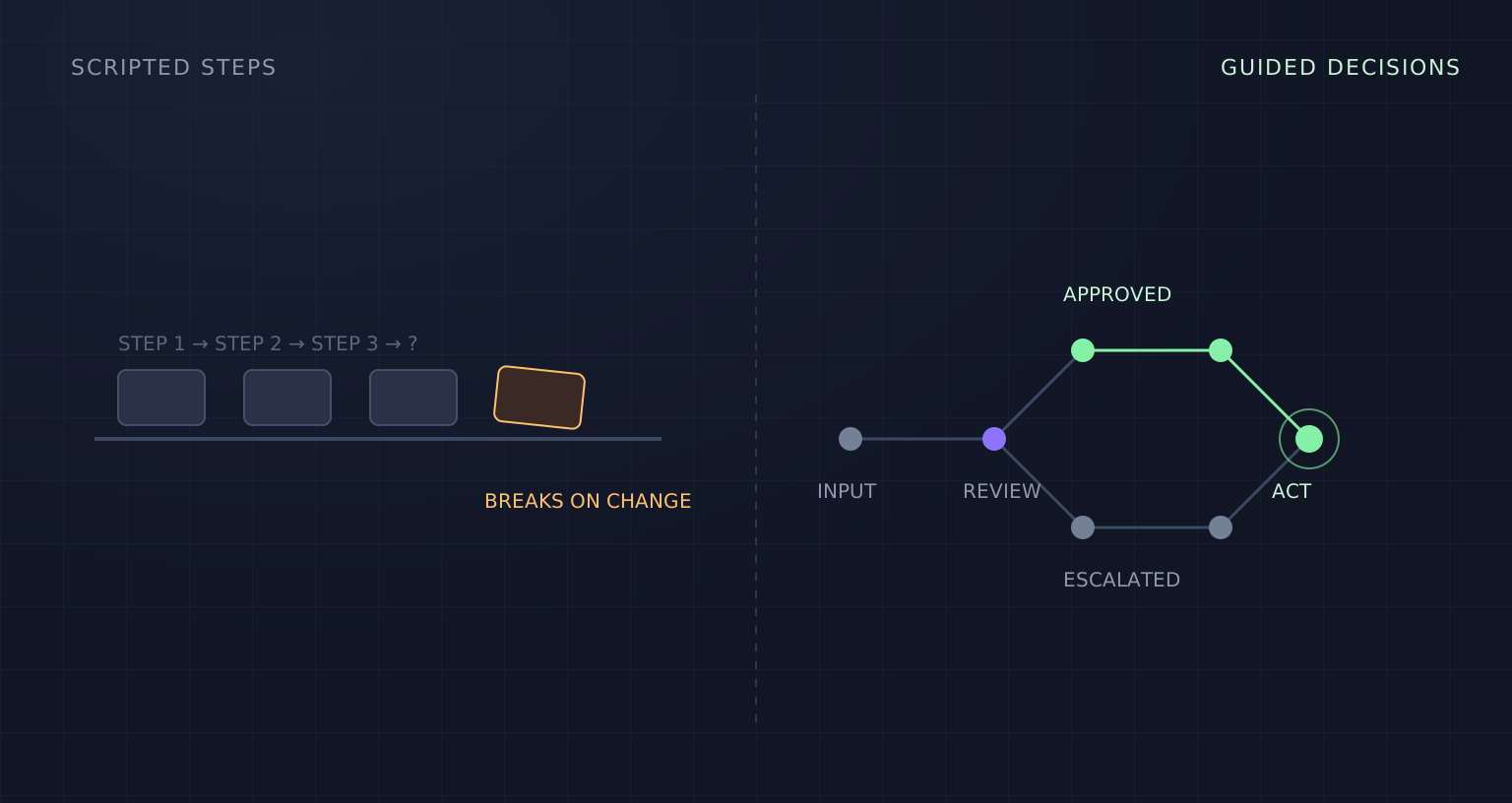
Robotic process automation (RPA) is software bots that follow fixed scripts. They click, copy and type through screens the way a person would. RPA earned its place in operations a long time ago. It posts invoices at 2 a.m., moves data between systems that have no API, and reconciles the same ten thousand rows every night without fatigue. If parts of your RPA estate work well today, this article will not tell you to rip them out.
The real question is narrower. When you compare RPA vs AI agents for a specific process, what actually changes? The honest answer is not "everything," and it is not "nothing." It depends on how much variance the work contains. The deciding evidence comes from your own cases, not from a vendor demo.
What RPA genuinely does well
RPA is deterministic. Same input, same action, every time. For a large class of operations work, that is exactly what you want.
A well-deployed bot posting invoices across three ERP screens will clear 4,000 invoices a day at a cost per transaction that falls to a few rupees. It does not slow down at month-end. It does not resign. And in systems too old to offer APIs, a bot that drives the screen is often the only integration option available. Most large operations run at least two such systems.
RPA also carries a governance advantage that is easy to forget: it is fully auditable and completely predictable. The script is the process. There is no ambiguity about what it will do next, because it can only do what it was told. A bot that has run clean for eighteen months is an asset, not technical debt.
Where RPA breaks in real operations
The limitations show up in three places, and anyone who has run bots for more than a year will recognize all of them.
- Interface changes. A bot clicks fixed selectors and coordinates. The carrier portal redesigns a button, and three bots stop on the same morning. Worse, a bot can keep running while typing into the wrong field.
- Exception paths. Scripts handle the happy path. Operations live in the exception path. Every new exception type is a new branch someone has to code, test and deploy.
- Judgment calls. "Is this document good enough to accept?" is not a rule. It is judgment shaped by experience. A bot can only escalate everything, which saves nothing. Or it guesses. That is real risk.
These RPA limitations compound into a maintenance tail. A team starts with three bots. Two years later there are thirty scripts, the developer who wrote them has left, nobody is sure which ones still matter, and every portal update triggers a week of emergency fixes. The automation budget quietly becomes a maintenance budget. In operations teams we review, it is common to find bot estates where maintenance consumes more effort than the original build ever did. A script nobody owns is not automation. It is a liability waiting for the next portal update.
Make it concrete. A shipment is marked delivered in the carrier portal, but the proof-of-delivery document is missing. The customer is asking. Here is what each technology does.
- The bot: the script checks the document field. The field is empty, so the case fails or escalates. Nobody coded a branch for "POD missing," so nothing else happens. The case waits for a person.
- The agent: it reads the case, checks the delivery scan in the portal, finds the driver-app reference in a second system, drafts a POD request to the carrier and routes it to a coordinator for approval. The coordinator clicks approve.
Now change one thing: the portal updates its layout overnight.
- The bot: the selector it clicks no longer exists. It fails. Worse, it can keep clicking whatever element moved into that position. Someone has to find the new selector and redeploy every affected script.
- The agent: it navigates by what is on the page, not by fixed coordinates. A moved button slows it the way it slows a new employee. It adapts without a code change.
Adaptability is not a license, though. The agent drafted a message to a carrier and proposed an action. That still needed approval rules, logging and limits. The same governance a well-run RPA estate always needed.
What AI agents change, and what they do not
What changes: variance and judgment-shaped steps. An agent reads unstructured input like emails, scanned documents and free-text complaints. It works out what kind of case it is looking at, and proposes the next step. It absorbs the twenty percent of cases that used to generate eighty percent of the script branches.
What does not change: governance. Gartner has predicted that over 40% of agentic AI projects will be cancelled by the end of 2027 (Gartner, June 2025), most often because teams deployed before they understood the workflow. That lesson is not about one technology. It is why evaluation discipline matters whether you keep RPA, replace RPA with agents, or run both. An agent acts on judgment, not just keystrokes. That raises the cost of skipping the process mapping, approval rules and audit trails that disciplined automation always required.
A decision framework that respects both
The decision is per process, not per technology. Keep RPA where the interface is stable, the rules are deterministic, the volume is high and the exception rate is low. The invoice-posting bot with an exception rate under 3%? Leave it alone. Consider agents where exceptions dominate, inputs arrive unstructured, and the real rules live in senior people's heads.
Either way, demand the same four gates before any system takes action:
- Understand the work (Observe). Map the process as it actually runs. Not the process document. Count the exception types and measure where the time goes. No actions are taken.
- Suggest without acting (Shadow). The system suggests what to do but does not take action. Its suggestions are scored against what your team actually decided and what happened next. The customer and Proxima agree a quality gate for each action category before testing.
- A person approves (HITL). A person reviews and approves each action before it happens. The system acts, but nothing commits without a human decision.
- Proven routine automation (Autopilot). Routine, proven actions run automatically within agreed limits. Only the categories that cleared the accuracy bar, with an audit log on every action.
Apply the same gates to new RPA work too. A bot that skips observation and shadow testing fails the same way an agent does. Just more quietly.
Migration reality: alongside, not instead
If the comparison points toward agents, the move is still not rip-and-replace. The teams that do this well run the two side by side. Pick one process where the bots visibly struggle, usually the queue with the highest exception rate. Run the agent in Shadow mode alongside the existing bots and the team, on real cases, for four to six weeks. Compare accuracy, handling time and escalation rate on the same cases. Then let the results decide the next step.
In practice this looks unglamorous. A mid-market operations team keeps its invoice-posting bots untouched. The agent is pointed only at the 15% of invoices that used to bounce out of the bot queue into a manual mailbox. For six weeks it suggests; people decide. If it clears the accuracy bar, those exception categories move to human-approved action, and only later to limited automation. The bots never went anywhere. The maintenance tail stops growing because nobody is coding new branches for judgment work.
That is the honest answer to RPA vs AI agents. It is not a replacement decision; it is a sorting decision, made process by process, on evidence from your own cases. The technology that earns more responsibility is the one that proves itself at each gate. That rule has never depended on which tool you pick.