A shipment exception is any parcel that leaves its planned path: a missed scan, a hub delay, a failed first delivery, an address problem, a return to origin (RTO). The delay itself is visible and easy to count. The follow-up around the delay is not, and it is usually the larger cost. Every exception pulls dispatch, customer service and the account team into the same case, often without any of them knowing the others are already on it. The parcel is late. The real cost is the three people chasing it.
The numbers are worth doing once, for your own network. Consider a mid-size operation moving 5,000 parcels a day. At a typical 6-8% exception rate, that is 300-400 cases a day, and festival-season volume can double it. If each case takes 25-40 minutes of combined follow-up across the three teams, the network is spending 150-200 hours a week chasing information that already exists somewhere. It is sitting in the carrier portal, in the transport management system, or in someone's WhatsApp thread.
The delay is not the expensive part
Break one exception open and the cost has four layers. The first is the follow-up time. Dispatch checks the carrier portal. Customer service calls the hub or scrolls through group chats. The account team drafts an explanation for the client. Three people touch the same case, and each one starts from zero because the work is not shared.
The second layer is RTO margin loss. A parcel returned to origin on a cash-on-delivery order carries forward freight, reverse freight, packing and handling. On a typical e-commerce shipment that is commonly ₹150-₹250, before the lost sale itself. Networks with high RTO rates feel this as a slow leak rather than a single visible loss.
The third layer is service-level agreement (SLA) credits. Contracted delivery windows carry penalties, and an exception that ages past its window converts directly into credits against the invoice. The fourth layer is the customer promise. Every hour an exception waits without an owner, the promised delivery date gets harder to keep, and the call that eventually comes from the customer is more expensive than the update that should have gone out first.
Why the default fixes fail
Most operations teams respond to a growing exception queue in one of three ways. All three treat visibility as the fix, and all three leave the actual gap untouched. That gap is ownership, and a tested recovery path.
- More coordinators. The queue moves faster for a few weeks, then volume catches up. Costs now scale linearly with shipments, which is exactly the model festival season breaks. And each added coordinator is one more handoff an exception can wait inside.
- More WhatsApp follow-ups. Messages move faster, but ownership does not change. Decisions live in chat threads, nothing is measured, and the same case gets chased twice while another case gets chased never.
- Another dashboard. Dashboards are good at showing that exceptions exist. They do not assign an owner, suggest a recovery, or send the customer an update. If nobody is watching the screen at 21:00, the exception waits until morning anyway.
The pattern underneath all three: the team can already see the exceptions. What it cannot do is get each case to an owner with a clear next action before the delay compounds. That is a routing and decision problem, not a visibility problem.
Four steps that actually reduce exceptions
A systematic approach to shipment exception management has four steps, in this order. Skipping a step is how automation projects end up as the fourth failed fix on the list above.
- Map where exceptions wait. Not where they occur. Where they wait. Between the carrier portal and dispatch. Between dispatch and customer service. Between "flagged" and "owned." Measure idle hours per handoff; the map almost always shows a small number of handoffs holding most of the total wait.
- Measure the categories by frequency and cost. Missed scans, hub delays, failed first deliveries, address problems, RTO triggers. Count weekly volume per category and attach the follow-up minutes and rupees each one carries. Two or three categories usually carry most of the cost, and they are rarely the dramatic ones.
- Test routing suggestions without acting. The system reads the same events your team sees and suggests what to do but does not take action (Shadow mode). Every suggestion is scored against what the team actually did and how it turned out. Nothing moves forward until the action category clears the quality gate agreed before testing.
- Approve first, then automate what proves safe. A person reviews and approves each action (HITL, human-in-the-loop). Re-routes, re-attempts and customer updates go out only behind a supervisor's approval. Categories that stay accurate week after week graduate to routine, proven actions running automatically within agreed limits (Autopilot). Complex cases stay with people.
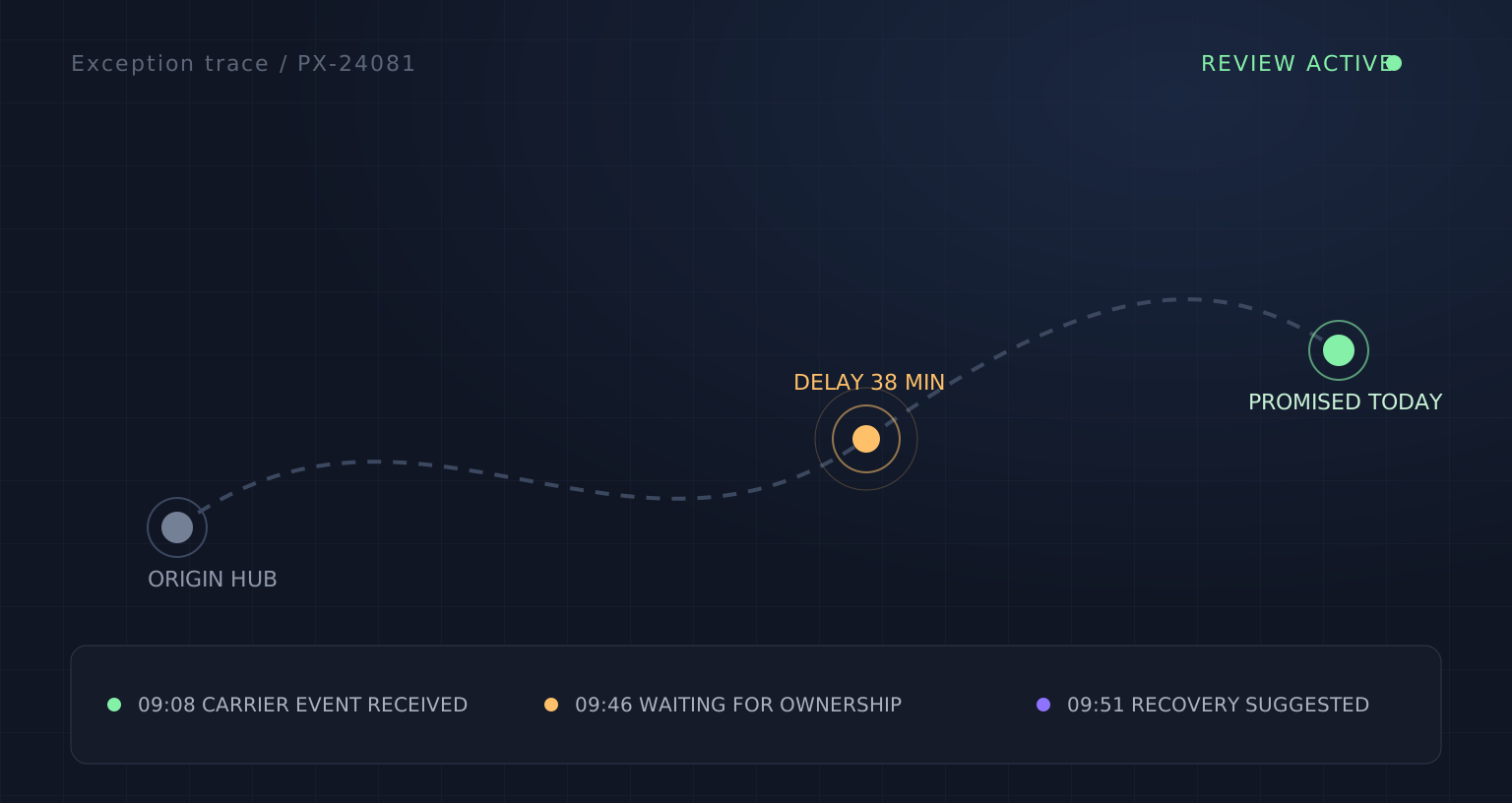
Here is what steps three and four look like on a real Tuesday morning. 09:08, the carrier portal logs a hub-congestion event against a Delhi-to-Bengaluru line-haul, 14 parcels on the manifest. 09:46, the case is still unassigned; 38 minutes have passed between dispatch and customer service with no owner. This is exactly the wait the map in step one is looking for. 09:51, the system suggests a re-route: move the manifest to the 11:30 line-haul via a different hub, with the supporting events attached and the new delivery times calculated. 09:54, a supervisor approves. The recovery runs, and the customer gets an updated delivery time the same morning instead of an apology call the next day.
The detection was never the hard part. The portal knew at 09:08. What changed is that the 38-minute wait for ownership collapsed toward zero, and the action went out behind a human approval with the evidence attached. That is the difference between another screen that shows problems and a system that helps close them.
What good looks like after six weeks
The team is the same size. That is the point. The routine categories (missed-scan follow-ups, standard re-routes, delivery re-attempts, proactive customer updates) are being handled behind approval, and the ones with a long accuracy record are running automatically within limits the supervisors set. The coordinators who used to chase portals all morning are working the cases that actually need judgment.
Exceptions close the same day. Median time from event to resolution drops from days to hours, not because anyone works faster, but because no case sits unowned. Customer promises are kept behind approval: the update goes out before the customer calls, and the account team stops writing apology mails. The weekly operations review changes shape too. Instead of asking "why did this fail," the team looks at accuracy by category and decides which one graduates to less supervision next.
What this does not fix
Carrier data stays messy. Status codes differ across carriers, scans get missed, and addresses stay incomplete. A system can work around that reality; it cannot clean it up, and anyone who promises otherwise is selling the fourth failed fix.
The automation stays inside routine recovery paths. Re-routes, re-attempts and customer updates within agreed limits are candidates. Damaged-goods disputes, high-value RTO decisions, unusual client commitments. These stay with people, permanently. The approval rules, limits and escalation paths are set with your supervisors, and your supervisors can tighten or loosen them at any time.
Shipment exception management improves when the follow-up disappears, not when another tool appears. Map the wait, measure the categories, prove suggestions before acting, keep approvals with people. It is boring on purpose. And it is what lets the same team carry the peak season without new headcount.