
It arrives in every serious evaluation, usually after the demo has gone well: “But can I actually let this thing talk to my customers?” It is the right question, and it deserves better than reassurance. The honest answer is that trust in an AI agent is not a feeling you develop — it is a structure you inspect. Either the design makes bad outcomes hard, or it does not. Here is what “makes bad outcomes hard” looks like at operator level, the same structure we run ourselves against.
The foundation is the phased trust model — automation earns autonomy category by category, from shadow mode to approval to autonomous-within-limits. This piece is the practical companion: once something is running, what physically stops it from doing damage?
The policy wall
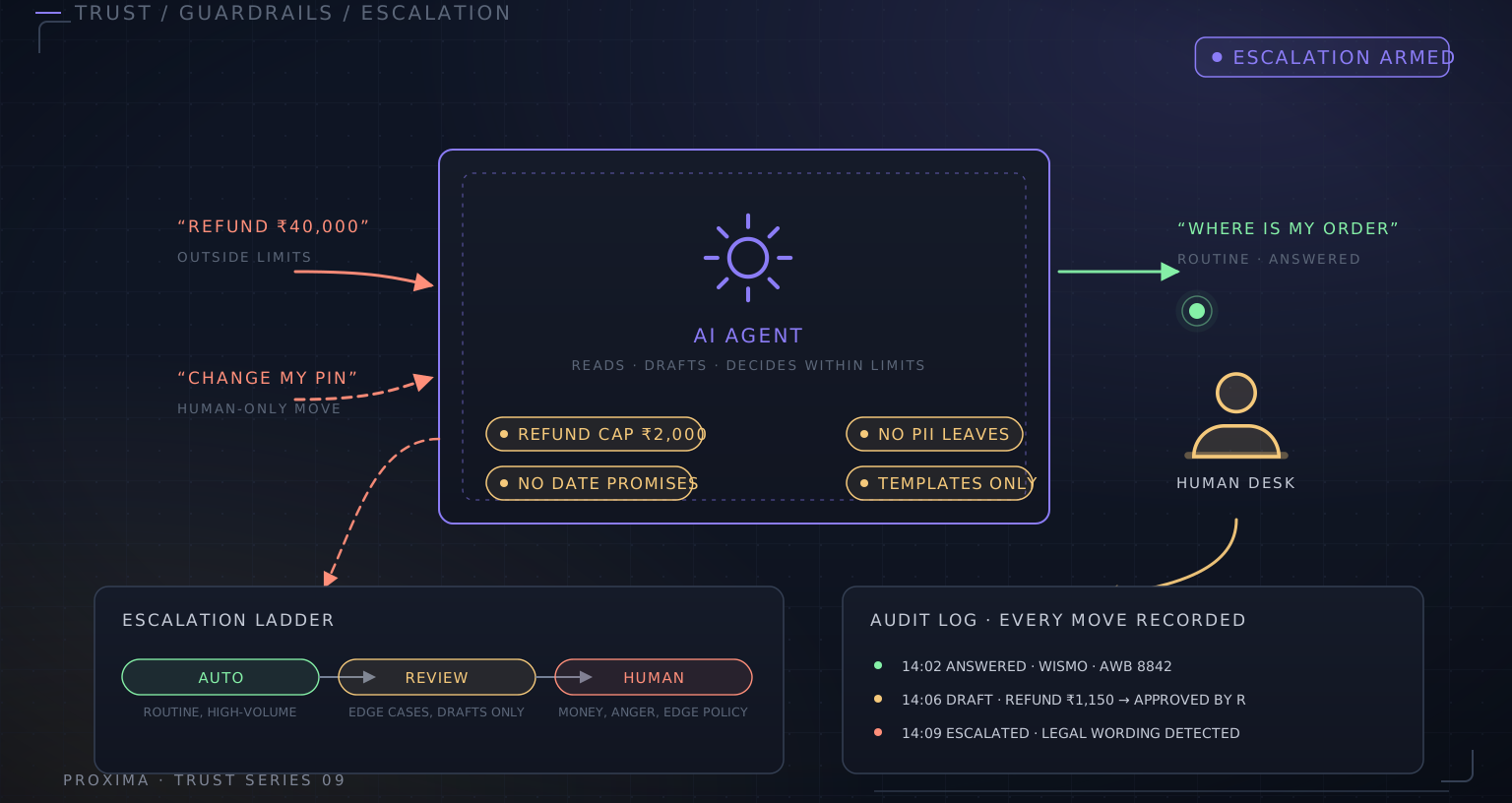
An agent’s capabilities should sit inside limits it cannot edit. Refund caps: the agent can release up to ₹2,000, in-policy, to the original payment source — nothing above, nothing to a “new bank account”, nothing as goodwill. Communication limits: approved utility templates only, no promises the data cannot back (no invented dates, no “guaranteed”), no discounts invented on the spot. Data limits: no personal data leaves the approved systems, nothing gets pasted into third-party tools, masked bank digits stay masked. Action limits: read everything, write almost nothing — and every write is reversible and logged.
The wall is boring by design. When a request hits it — “refund my ₹40,000 order” — the correct behavior is not a creative attempt at helpfulness. It is a clean bounce to the escalation path with context attached. The list of what bounces is a policy your team writes and revises, which is precisely why the wall can be trusted: it is your judgment, encoded and enforced, not the model’s judgment on a good day.
The escalation ladder
Not everything is routine, and the design has to say which is which. A three-tier ladder covers the space:

- Tier one, automatic: the routine and high-volume. WISMO with a clean scan history, refund status with a computable date, COD confirmation. The agent answers; QA samples the output daily rather than reviewing each one.
- Tier two, drafts only: the edge of routine. Exchange negotiations, refunds ₹2,000-10,000, anything where tone detection has flagged anger or confusion. The agent prepares the reply and the evidence; a person reads it and hits send. The human is faster because the work was done, and safer because the judgment is theirs.
- Tier three, human-only: money, anger and edge policy. Refunds above the cap, legal or threat wording, VIP and repeat-complaint cases, anything touching media or consumer-forum language. The agent’s job here is a clean handover — summary, history, next steps — not an answer.
The trust question largely dissolves inside this ladder. “Can it talk to my customers?” splits into “can it tell someone where their parcel is?” (yes, provably) and “can it apologize for a damaged ₹40,000 order and negotiate compensation?” (it never gets to; a person does). Most objections are about the second question and vanish when the answer is “never”.
The audit trail
Every action, logged: what the customer said, what the agent read, what it replied, what rule fired, what a human changed. Not for compliance theater — for the two moments the log actually earns its keep. The first is the incident: a customer says “your agent promised me a refund”, and in thirty seconds you have the transcript, the rule, and the truth of what was promised. The second is the improvement loop: weekly review of what bounced off the wall tells you which limits are wrong, which templates are weak, which tier boundaries should move. A trustworthy agent is not one that never errs; it is one whose errors are visible, attributable and cheap to fix.
What actually goes wrong (and does not)
The failure modes worth planning for are rarely the cinematic ones. The model confidently hallucinating a refund policy is mostly solved by the wall: the agent cannot invent money movement it cannot execute. The real risks are quieter. Stale data: the agent answers perfectly from yesterday’s scan feed — the fix is freshness checks and a refusal rule (“no answer without data newer than X”). Scope creep by request: a customer politely negotiates a routine thread into an exception — tone and topic rules move it to tier two. Template erosion: marketing copy creeping into utility templates, which is a review process, not a technology. And the human side: reviewers rubber-stamping drafts after three quiet weeks — which is why QA samples tiers forever, not just at launch.
Against this, put the baseline honestly: your human queue today mis-answers under load, makes refund exceptions inconsistently, and loses context between shifts. The comparison is not “agent versus perfect”; it is “agent with a wall versus queue at 2am in November”. It is also not a chatbot — the kind that echoes status codes and escalates nothing, which is what gave the category its trust problem in the first place.
The questions to ask any vendor
Turn the structure into a checklist. Where are the policy limits enforced — in the prompt, or in code the model cannot edit? (The second.) What is the refund/action cap, and who changes it? Show me the escalation path on a real angry thread. Show me the audit log for one conversation. What did shadow mode measure, and against what standard? What does the weekly review look like after launch — who reads it? A vendor with answers is showing you a designed system. A vendor with adjectives is showing you a demo.
Earned, then re-earned
Trust in an agent is not a milestone; it is a maintenance schedule. The limits that made month one safe get revisited at month three with better data — caps raised where the record is clean, tightened where it is not. The forward-deployed approach exists partly because this tuning is operator work, not vendor-support-ticket work: the people who know the brand’s judgment sit with the people who know the machine’s seams.
So: can you trust an AI agent to talk to your customers? Inside a wall you drew, up a ladder you set, under a log you read — yes, the same way you trust a new hire who has earned their levels, or a courier with a signed SLA. Not with your eyes closed. With your limits enforced.