
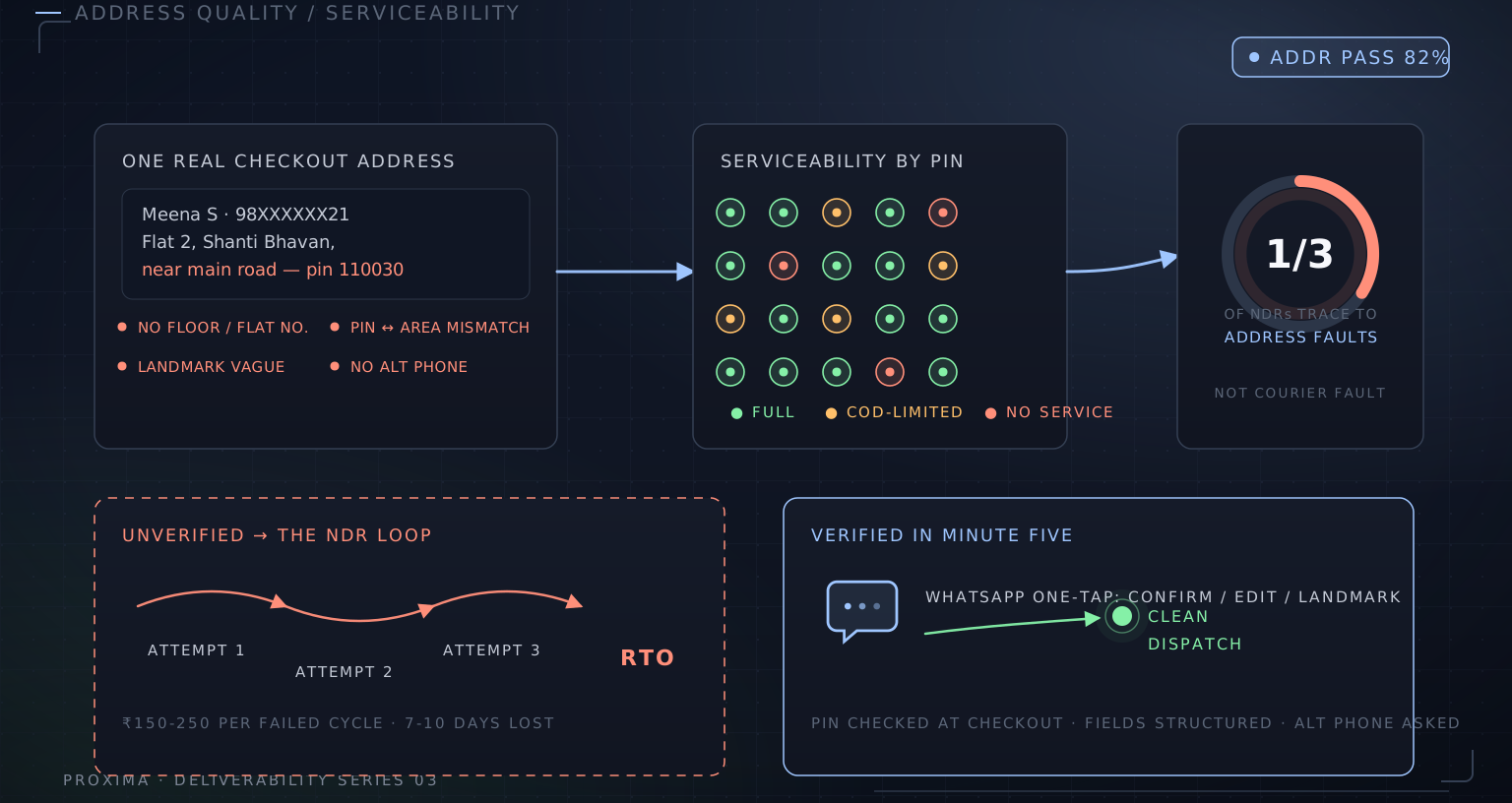
When a delivery fails, the first suspect is always the courier. Sometimes it is the right one — riders miss, networks slip, festive backlogs happen. But pull your NDR data apart by reason code and a different picture emerges: a large share of “customer unavailable” and “address incomplete” failures are address problems that existed before the parcel left your warehouse. Teams that tag carefully commonly find a quarter to a third of NDRs trace to address faults. Every one of those costs the same three attempts, the same 7-10 days, and the same march toward RTO as a genuinely missed doorbell.
The unfair part: you paid for the problem at checkout and paid again at the door. The good part: address quality is one of the few logistics problems that gets cheaper to fix the earlier you touch it — and the earliest touch is a form field.
Anatomy of a bad address
Indian addresses are hard for a reason. Half the country lives in settlements where the addressing system is narrative, not numeric: “the blue gate near the water tank, second lane after the temple.” That works beautifully for a human with local knowledge. It fails for a rider with 60 stops and no context. The common faults, in rough order of frequency:
- No floor or flat number. “Shanti Bhavan” in a building with four floors and two flats per floor is a coin flip.
- No house or plot number. The narrative address with no anchor point.
- Vague landmarks. “Near main road” in a town where the main road is eight kilometres long.
- Pin-area mismatch. The pin code maps to a different colony than the street named — often a neighbouring one, sometimes a different city.
- No alternate phone. The one number given is on another network, out of coverage, or answered by no one during delivery hours.

Fix capture first, not last
Google-type address autocomplete helps where it works and misleads where it guesses, so treat suggestions as a convenience, never as verification. Verification is a different step, and it happens after the order.
Verify in minute five
The COD confirmation window — the first five minutes after an order — is also the address verification window, for prepaid orders too. One WhatsApp message: the address as captured, a confirm button, an edit button, and one line asking for “a landmark within 200 metres”. Buyers fix their own addresses at remarkable rates when asked immediately, because their phone is still in their hand and their intent is still warm. The reply, structured, lands back in your OMS before the pick list prints.
The share of orders this needs to touch is a targeting question, not an all-orders question. Verify: first-time buyers, COD above a value threshold, addresses whose pin-area check failed, and any address with an empty landmark field in a high-density metro pin. Everyone else ships on capture alone.
Serviceability is a data table, not a checkbox
The second half of the problem is what your courier can actually do at a pin code — and “serviceable” is not one bit. The useful version is a per-pin table, refreshed weekly, with: forward COD service, forward prepaid service, reverse pickup service, expected TAT band, and the same for your second and third courier. Three decisions fall out of that table:
- Promise the date you can keep. EDD by pin, not a flat “3-5 days” that is true for metros and false for the Northeast. The promise that fails is the first domino in a refusal chain.
- Route by reality. Some pins deliver beautifully on one network and poorly on another. Allocation by pin-level performance is the core of a multi-courier strategy.
- Restrict with precision. The pin where COD loses money consistently does not need a COD ban on the whole district — it needs COD made prepaid-only for that pin, or a delivery-charge adjustment. Narrow rules, reviewed monthly, beat blanket policies.
Keep the table honest by reconciling it against outcomes: your own delivered/NDR data by pin is the ground truth that corrects whatever the courier’s API claims this week.
What the NDR residue tells you
After capture and verification, the NDRs that remain are mostly real: the buyer was out, the rider was early, the phone was busy. That residue is a recovery problem, and it has a playbook — NDR management covers the same-day WhatsApp, the reschedule offer and the COD-to-prepaid save attempt. The point of this piece is that the residue should be small. If your NDR rate is 12% and a third of it is address faults, no recovery process can be cheap enough to make that structure work. Fix upstream; recover downstream; measure both.
One quiet bonus: the verified-address corpus becomes an asset. Repeat buyers order again to an address that is already clean, and your confirmation messages get shorter, and your first-attempt delivery rate on repeat orders quietly climbs. Address data compounds in a way almost nothing else in logistics does.
Where automation fits
The pin-area check, the verification-message targeting, the structured reply parsing and the weekly serviceability refresh are all rules-and-data work — well-suited to automation, with the same safety sequence as always: shadow it against what your team sends, then approve, then run within limits. What stays with people: the field design itself, the pin-level restriction rules, the value thresholds, and every decision to stop shipping somewhere. Those are policy calls with revenue attached.
An hour of address work at checkout saves a week of attempt loops at the door. Few lever arms in Indian e-commerce are that long.