
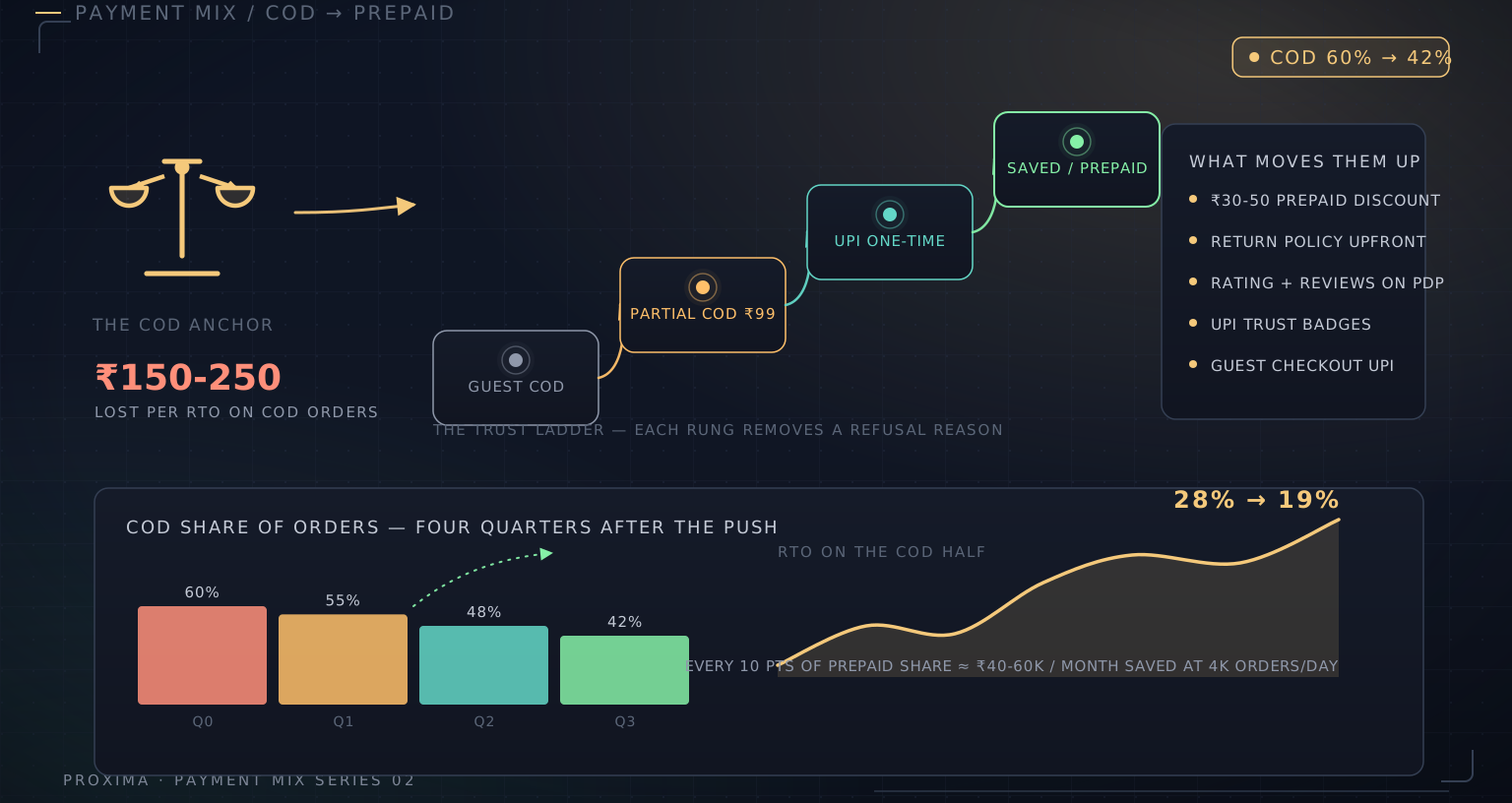
Ask an Indian D2C founder what causes their RTO problem, their cash-flow problem and their festive-season working-capital problem, and you usually get three answers. There is mostly one: cash on delivery. In categories like fashion, footwear and electronics accessories, 55-70% of orders are COD. Those orders return at two to three times the rate of prepaid ones, pay you a week or more after dispatch, and cost a fee to remit on top. Every post on this blog about reducing RTO, confirming COD orders and recovering failed deliveries is, at some level, a post about managing the consequences of that one preference.
This piece is about the cause itself. Not “force everyone to prepaid” — that trades a logistics problem for a conversion crash. The practical version is a ladder: give the buyer a reason and a route to move one rung up, and let the rungs add up.
Why the buyer pays at the door
The COD preference is rational, not stubborn. The buyer has been burned by a brand that never shipped, a parcel that arrived broken, or a refund that took three weeks and forty messages. Paying at the door keeps all the power on their side of the transaction. Surveys keep finding the same top reasons: fear of non-delivery, product-not-as-expected risk, and refund distrust. Notice what all three have in common — none of them is about the act of paying.
That is why the fix is never a checkout restriction. It is evidence. The buyer needs to see, before they pay, that delivery happens, that returns work, and that refunds land. The brands that moved their COD share from 60% to the low 40s did it by making prepaid the visibly safer option, then pricing the nudge.
The ladder, rung by rung

Rung one: guest COD, made honest
The buyer stays on COD. Your job on this rung is only to make the order a good one: confirm it on WhatsApp within minutes, verify the address, and give one clean cancel button. A confirmed, well-addressed COD order refuses at the door far less often. This rung does not change your payment mix — it changes the quality of the COD you keep.
Rung two: partial COD
Also called COD with a token, this asks the buyer to pay a small amount upfront — ₹49, ₹99, sometimes 10% of the order — and the balance at the door. It sounds like a small thing. It is not. The token filters out almost all accidental and low-intent orders, because a buyer who pays ₹99 has answered the question “did you mean to order this?” with money. Brands running partial COD commonly see refusal rates on these orders fall close to prepaid levels, while keeping the door-payment the hesitant buyer still wants.
Run it as an experiment, not a mandate: show the option with a small perk attached (a ₹30-₹50 discount or free shipping on the token), and let the buyer choose. The data you get — who takes it, who refuses at the door after taking it, by pin code — is worth more than the conversion you might lose.
Rung three: full prepaid, one-time UPI
UPI made this rung possible for guests. No card, no saved instrument, no wallet balance — a QR scan or a one-tap mandate, done in twenty seconds. The barriers left here are pure trust, which is what the next section is about. If your checkout still leads with cards and buries UPI, you are keeping buyers on rung two who were ready for three.
Rung four: saved, repeat prepaid
Account holders with a saved UPI mandate or card order again with two taps and never think about payment. Every repeat buyer you move here stops being a payment-mix statistic at all. The lever is the post-purchase experience: fast delivery updates, painless returns, refunds that land before the promised date. Do that twice and rung four takes care of itself.
Price the nudge against the RTO, not the margin
The discount question always comes down to “how much”. The honest answer comes from your own ledger. An average COD RTO costs ₹150-₹250 in forward freight, reverse freight and handling, before the lost sale. A ₹40 prepaid discount that converts an order is not a margin giveaway — it is buying out a risk that costs four to six times more. When a brand sizes the nudge this way, “we cannot afford discounts” usually flips to “we cannot afford not to”.
Three nudges that work in India, roughly in order of strength: a flat ₹30-₹50 off, free shipping where shipping is charged, and priority dispatch (“pay now, ships today”). The last one is interesting because it sells speed, not safety — buyers who would never admit distrust happily pay now for a Diwali gift that must arrive by Thursday.
The RTO cost calculator on this site does this arithmetic from your own numbers in about ten seconds.
The trust signals that do the heavy lifting
Discounts move buyers who were nearly ready. Trust signals move the rest, and they cost less:
- The return policy in plain sight, in plain language. Not a link to 2,000 words of terms — five lines on the product page: 7-day returns, pickup from your door, refund to source in 5-7 working days.
- Real ratings on the product page. A PDP with 400 ratings and visible negative ones reads as honest; a PDP with twelve five-star ratings reads as curated. The buyer’s brain is doing refund-risk math, and moderated-looking praise does not help it.
- Delivery proof, not delivery promises. “92% of orders in your pin code delivered in 3 days” with a date range beats “fast delivery” every time. If you cannot say something that specific, that is a courier problem wearing a trust costume — choose the courier before you write the badge.
- Refund speed, advertised and true. The single strongest prepaid signal a brand can send is a refund that lands before the promised date. Every fast refund is a private advertisement for the next prepaid order.
What not to do
Three moves backfire. Removing COD entirely works only for brands whose demand outruns their supply; for everyone else it is a conversion hole, and it punishes exactly the first-time buyer you are trying to convert. Charging a “COD handling fee” without offering anything in return reads as a fine for distrust. And hiding the COD option behind collapsed menus and dark patterns buys a few prepaid orders and a permanent trust debt — the buyer who finds it anyway now knows how you feel about them.
Where automation fits
The ladder has three automatable steps. The confirmation message on rung one, with the prepaid nudge attached, is a template with a payment link — the five-minute window post covers it in detail. The rung-two experiment is a rules problem: who sees the partial-COD option, at what token size, with what perk. And the follow-through — delivery updates, refund status answers — is what makes rung four happen; the proactive notifications approach handles it before the ticket exists.
What stays with people: the token size, the discount budget, the pin-code rules where COD gets restricted after losses, and every exception. Those are pricing and policy calls, not messaging ones.
Watch the mix, not the moment
Moving COD share is quarter work, not week work. Track it monthly alongside RTO rate on the COD half, prepaid conversion at checkout, and refund TAT — because the honest discount you fund is only defensible if the refund experience backs it up. Ten points of COD share, at 4,000 orders a day, is roughly ₹40-60k a month of RTO that never happens. The ladder gets you there one rung at a time, and the buyer thanks you for each one — quietly, by paying.