
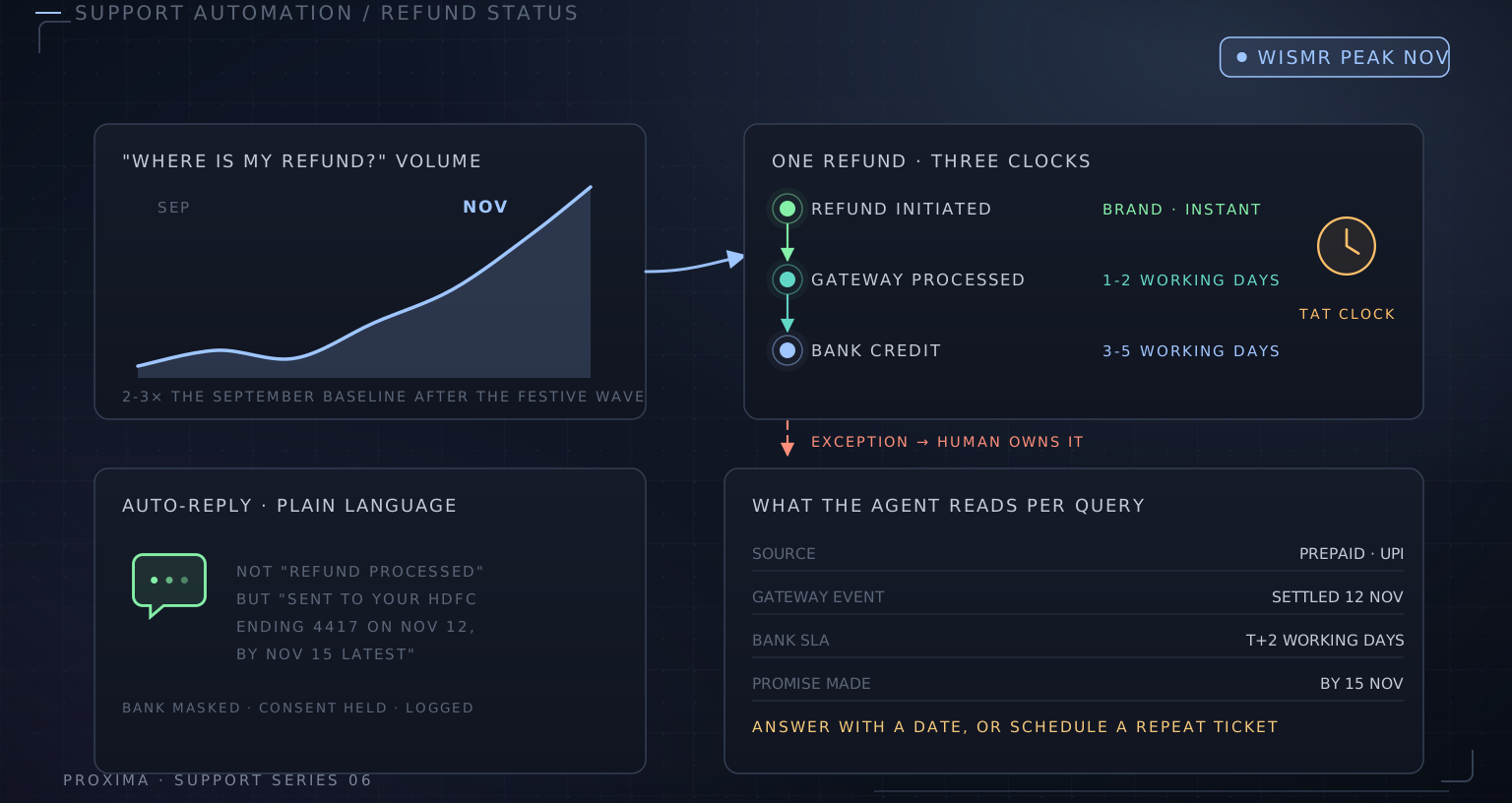
Every support queue has two questions that dominate. “Where is my order” is the bigger one, and it has a whole post of its own. The second is its anxious sibling: “where is my refund?” It arrives after the order is done, the return is picked up, and the customer has already waited — which means every hour of silence now reads as stalling. In the six weeks after the festive season, when returns arrive 2-3× baseline, refund status queries arrive on the same curve.
Like WISMO, the strange part is that this is not a request for help. It is a request for information the company already has. The refund’s state sits in your OMS, the payment gateway’s dashboard, and the bank’s pipeline. The customer is asking a question three systems already know the answer to. The support ticket exists because nobody translated.
One refund, three clocks
To answer honestly, you have to know where the money actually is. A refund runs through three clocks, and only the third one exists for the customer:
- The brand’s clock. QC passes, your system releases the refund. This part is yours — it should be same-day, and if it is not, that is the first fix. No automation downstream can excuse a three-day release delay you control.
- The gateway’s clock. The payment gateway processes the reversal on its settlement cycle. UPI refunds are fast — often hours. Card and netbanking reversals commonly take 1-2 working days at this stage. COD refunds routed to a bank account start as a NEFT transfer with its own cut-offs.
- The bank’s clock. The customer’s bank credits the account. Another 1-3 working days depending on method and bank, and this is the part nobody can expedite — which is exactly why the promise must include it.

Add the clocks per payment method — UPI, card, netbanking, COD-to-bank — and you have the honest promise: “credited by November 15”, not “5-7 business days” with a clock nobody can find the start of.
Why the tickets happen
Three gaps produce almost all refund tickets. The promise gap: the refund was promised from the wrong starting point (“5-7 days from pickup” when the clock actually starts at QC, which was four days after pickup). The silence gap: no update between “refund initiated” and money-in-bank, which is a window of days in which the customer’s imagination does the communicating. And the answer gap: when the customer finally asks, they get “processed from our end, please wait” — true, useless, and a guaranteed repeat ticket in 48 hours. A vague first answer does not close a refund ticket; it schedules the next one.
What a good answer looks like
Take the honest machine-readable state and translate it:
- Return received, QC passed November 12. The money moved the same day.
- Sent to your HDFC account ending 4417 on November 12. Method-specific, bank named, digits masked.
- Banks take up to 2 more working days — expect it by November 14, end of day. The date, with the reason it is true.
- If it is not there on the 15th, reply here and a person takes it. The escape hatch that makes the promise trustworthy.
That is four lines, and it ends the conversation. No bank detail beyond the masked suffix, no gateway jargon, no “kindly wait”. Every element is computed from data: the QC timestamp, the gateway event, the method’s SLA, plus one working day of grace on the promise.
What the automation reads
Per query, the system needs five things: the order and its refund record (source payment method, amount), the return’s state from the returns pipeline (picked up, received, QC passed — with timestamps), the gateway’s event feed (initiated, settled, failed), the method-specific bank SLA, and the promise already made, if any. From those it composes the answer with a date. Exceptions — failed transfers, refunds stuck past promise, gateway webhook gaps — route to a person with the full context attached, not a bare ticket title.
Notice what is not in that list: judgment. Refund amounts, refund policy exceptions, goodwill credits and “where is my refund” asked with legal threats attached are not status questions. The automation answers state; people answer everything else. That line keeps the whole thing safe, and it is the same line we draw in the guardrails piece.
The proactive version
The best refund ticket is the one never raised, and refunds have natural message moments: QC passed and refund released (“sent to your bank, expect it by the 14th”), and the day before the promise (“your refund should land tomorrow”). Two messages, both computed from the same state, both proactive notifications in exactly the WISMO-prevention style. Brands that send the first one typically watch the “where is my refund” queue fall by half before touching any answering automation — because half the tickets were just silence being interpreted.
Timing, for the festive wave
This is an August-to-September build for an October-to-November problem. The returns surge after the festive sales drags refund volume up for six weeks, and it lands on the same support team that is already tired. A refund-status automation running in shadow mode by mid-September, approved by early October, answering routine state queries by late October — that sequence turns November from survival into a queue that stays flat while everyone else’s triples. The post-festive prep piece places this in the full readiness picture.
What this does not fix
Automation cannot make a slow refund fast. If your release takes three days because QC is backlogged, fix the bench. If the gateway settles late, that is a terms conversation. What the automation does is make the wait honest — which, to a customer deciding whether your brand gets a second order, is most of the battle.